
JSC "Ukrzaliznytsia" urges businesses to make maximum use of "block train" shipments (unit trains) for cargo transportation.
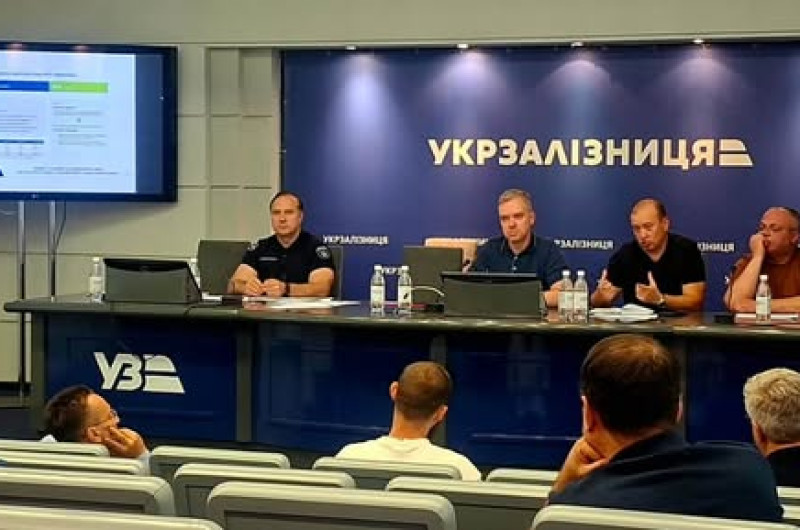
During the event, Valerii Tkachov, Deputy Director of the Department for Transportation Technology and Commercial Operations, presented the mechanisms currently being employed to address the issue of railcar accumulation across the network.
"Given infrastructure constraints, Ukrzaliznytsia prioritizes block train shipments. This is the most efficient transport method, as it minimizes the need for train reconfiguration at marshalling yards. Consequently, this will enable a larger volume of cargo to be transported to western border crossings within a shorter timeframe," noted Valerii Tkachov.
He added that five specific instruments are currently being utilized, including:
• monthly planning;
• daily planning for cross-border transfers;
• monitoring of daily loading volumes;
• prioritization of shipments;
• application of "conventional bans" (temporary operational restrictions).
The Ukrzaliznytsia representative emphasized that this prioritization applies to all stages of the transportation process: monthly planning, the scheduling of train transfers at the border, transit across the network, and the provision of traction (locomotive power), among others.
Priority shipments are categorized as follows:
1. Transportation of vegetable oil and petroleum products via block trains (in accordance with Cabinet of Ministers of Ukraine Resolution No. 1300); 2. Priority for mining and metallurgical products shipped to EU enterprises to support continuous technological and production processes (specifically, metallurgical plants);
3. Block train shipments for cargo not falling under the first or second priority categories;
4. Single-wagon shipments.
For their part, business representatives offered their own comments and proposals. For instance, they suggested classifying the transport of meal (oilseed residue) as a second-priority category, as the operations of oil extraction plants depend on it.
Shippers using containers pointed out that when vegetable oil is transported in containers, it is not granted priority status; they requested that a solution be found.
Furthermore, it was proposed to utilize so-called "consolidated" block trains—assembling a full train from wagons collected at several different stations. Valeriy Tkachov noted that such a train must have a single consignor.
A proposal was also made to designate specific border crossings exclusively for the transfer of mining and metallurgical cargo. Suggested locations include the Izov–Hrubieszów (Poland) and Chop–Čierna nad Tisou (Slovakia) crossings.
Business representatives also requested information regarding the throughput capacity of border crossings, taking into account the established shipment priorities. Valeriy Tkachov stated that he would provide statistics on the transport of priority cargo, covering the periods both before and after the blockade of the Greater Odesa ports. A representative of Ukrzaliznytsia assured that the submitted proposals would be reviewed. He also encouraged companies wishing to share their ideas on improving transportation to do so in the near future, so that the railway operator could process them and, where possible, incorporate them into future operations.